
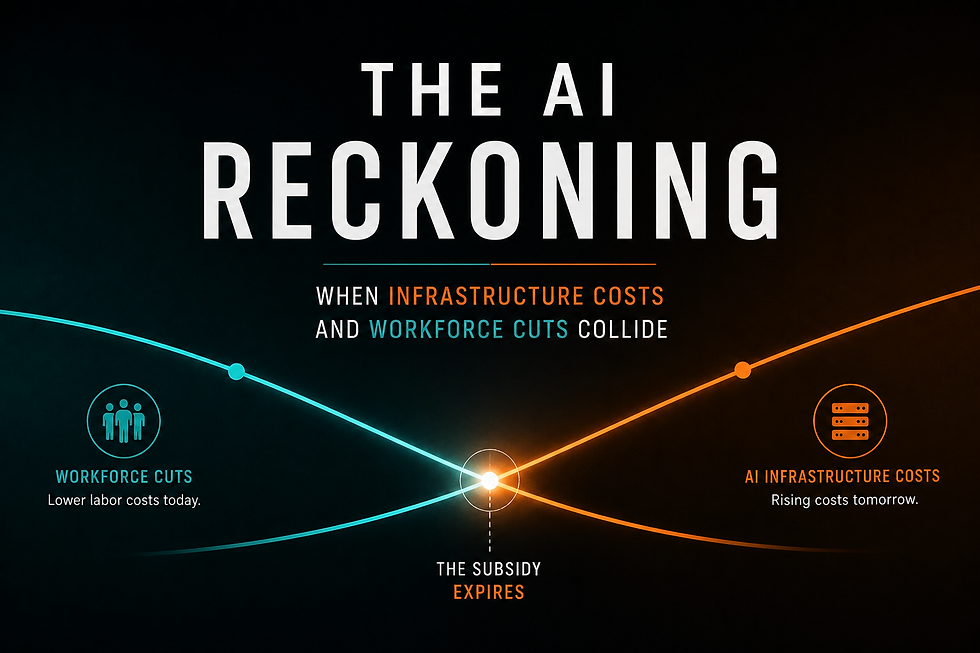
The AI Reckoning: When Infrastructure Costs and Workforce Cuts Collide
By Jason Ten-Pow
Every industrial revolution follows a familiar pattern: capital floods in, infrastructure is built, competition intensifies, and many companies fall away. The winners are often the ones who understood, before it is obvious to most, what it truly cost to build and sustain the infrastructure that powers the revolution.
We are in that moment now. AI has triggered two trends on a collision course: the rising cost of AI infrastructure, and the impact of AI on the workforce, specifically the reduction of the middle-management layer responsible for holding organizations together. Both trends have timelines. Both are accelerating. And almost no one is talking about what happens when they converge.
AI will not continue getting cheaper while replacing more human labor because AI infrastructure operates on uneven lifecycles: buildings last decades, mechanical and electrical systems require replacement every 10 to 15 years, and servers turn over every 3 to 6 years. The organizations that own this infrastructure, Microsoft, Alphabet, and Meta, understand this. In 2025, their earnings calls introduced new vocabulary for it: "compounding S-curves," "annual rhythm," "fungible fleets." Alphabet's depreciation expense grew 41% year-over-year in Q3 2025. Meta has acknowledged a deliberate shift toward shorter-lived assets. These organizations are already building the language to normalize rising AI costs.
Because organizations access AI through subscriptions rather than owning the infrastructure, the cost recurs and compounds. Every refresh cycle pushes costs downstream, into usage fees, pricing tiers, and service costs that subscribers are currently treating as fixed.
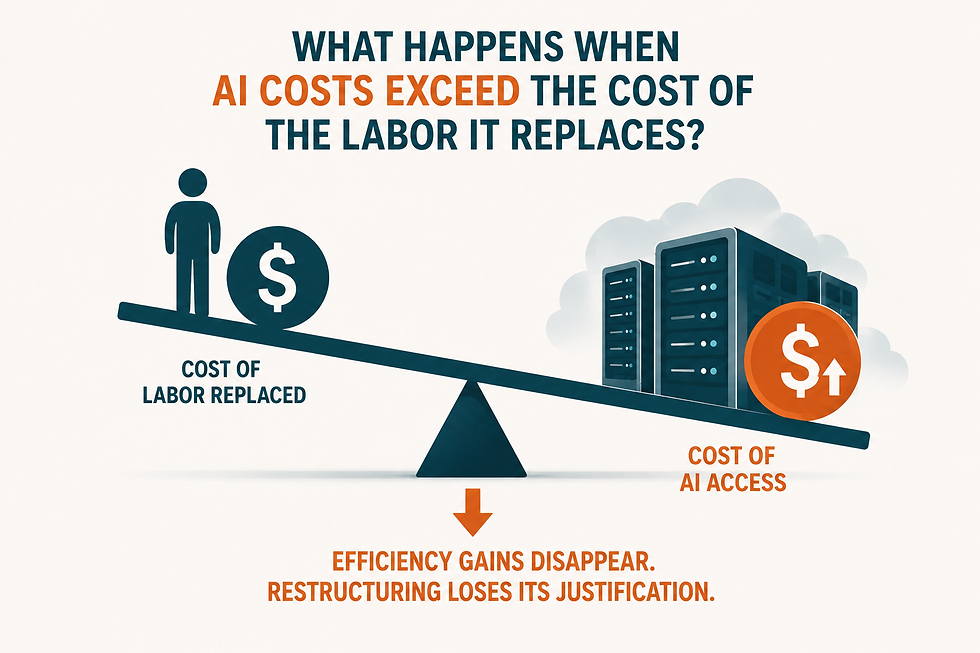
Right now, the cost of AI is subsidized. The companies providing it are absorbing infrastructure costs to drive adoption. And in this moment, the savings from eliminating human labor appear real and immediate. But the subsidy has an expiration date. The data centers powering this revolution are not charitable infrastructure. They are capital assets with investors, depreciation schedules, and refresh cycles that are already compounding. The cost of AI access is starting to rise to meet the cost of the labor it is rapidly replacing. What happens when AI costs begin exceeding the cost of labor being replaced and erasing the efficiency gains that are currently justifying the restructuring?
There is a false belief that companies can remove large portions of management and human infrastructure without long-term consequences. That is why rather than deploying AI as a force multiplier, an additive layer that amplifies what people can do, many organizations are pursuing a reductionist strategy. Why are companies choosing this path? They have been captivated by AI’s apparent cost advantages, while Wall Street continues to reward layoffs as signals of modernization and efficiency. In the process, the management infrastructure responsible for translating strategy into coordinated human action is being flattened and increasingly dismissed in earnings reports as overhead, friction, or bureaucracy slowing execution. What this narrative ignores is the actual function middle management performs and the immense organizational value that rarely appears in headcount cost analyes.
Healthy organizations run on a sequence that is rarely named but consistently present. Leaders set direction, and that conviction translates into market confidence. Managers translate leadership direction into human terms by interpreting it, reinforcing it, making it legible to the people doing the work. That translation becomes worker confidence: the sense that what I'm doing matters. From that place, workers bring something to customer interactions that no process can mandate, and no index can measure which is genuine investment in the outcome. That investment translates later into customer confidence because of quality products, engaging interactions and consistently positive experiences. Customer confidence drives purchasing, renewal, and the kind of loyalty that doesn't appear until it disappears. This is the confidence cascade.
The damage of removing management doesn't register in the quarter it's done. What erodes first is harder to see: the worker's belief that their job is worth doing well. When that belief weakens, pride follows. And pride is the fuel of discretionary effort, the care and ownership no AI can replicate. You simply cannot automate organizational culture.
When these two trends converge, rising AI infrastructure costs and the erosion of middle management, organizations will face a structural shock they may no longer be equipped to manage.
The companies currently celebrating flatter, leaner operating models will encounter a moment where the economics of AI shift. As infrastructure costs rise and the pressure to rapidly pivot intensifies, leadership teams will discover that the management layer once responsible for translating strategy into coordinated execution no longer exists at the scale required. The very people who operationalized change, stabilized teams, transferred knowledge, resolved friction, and adapted strategy in real time will have already been removed in the name of efficiency.
At that moment, the power structure will begin to flip again. Organizations that treated layoffs as routine maintenance and viewed human capability as interchangeable with AI systems will once again need the institutional knowledge, adaptability, and human coordination they dismantled. But rebuilding those capabilities will not be immediate, because the workforce has been learning a lesson through lived experience: the relationship between employee and company has become increasingly transactional.
Workers are hearing it in earnings-call language. They are experiencing it through quietly eliminated roles and through the silence where conversations about growth, mentorship, and long-term futures once existed. As trust erodes, so does loyalty, discretionary effort, and the willingness to help organizations navigate difficult transitions.
The greatest risk is not simply that companies automate too aggressively. It is that they hollow out the very human infrastructure they will eventually depend on when conditions change and adaptation becomes essential once again and simultaneously middle-management embraces loyalty as transactional.

In the end, the organizations that emerge stronger from this revolution will not be the ones that moved the fastest to reduce headcount. They will be the ones disciplined enough to understand where AI creates leverage, where human judgment remains irreplaceable, and how the two must work together to sustain performance, innovation, confidence, and growth.
This is the moment for leaders to move beyond the simplistic narrative of replacement and begin asking harder, more strategic questions about resilience, adaptability, and the long-term consequences of dismantling the human systems that hold organizations together. The future will not belong to companies that simply automate more. It will belong to those that build organizations capable of combining artificial intelligence with human intelligence in ways competitors cannot easily replicate.
The decisions shaping the future are being made now. The question is whether organizations will act with enough clarity and foresight before the cost of getting it wrong becomes far greater than the savings they are chasing today.